


Staying on top of your NYC property tax bill is one of the most important responsibilities of property ownership. Whether you own a co-op in Queens, a brownstone in Brooklyn, or a commercial property in Manhattan, knowing how to access, review, and pay your bill can help avoid late fees, correct errors, and reduce stress.
New York City provides multiple ways to find your bill—online, by mail, or directly through the Department of Finance
Table of Contents
- Key Takeaways
- What Is a NYC Property Tax Bill?
- How to Access Your NYC Property Tax Bill Online
- How Much Is Property Tax in NYC?
- How Does the Department of Finance Calculate Your Property Taxes?
- Where Do Your Tax Dollars Go?
- What If You’re Late in Payments?
- Frequently Asked Questions (FAQs)
- Working with Tax Experts on NYC Property Tax Bills
Key Takeaways
✔ Your NYC property tax bill outlines charges, exemptions, credits, and payment details.
✔ Bills are issued quarterly or semi-annually, depending on your property’s assessed value.
✔ Property tax rates vary by tax class. For example, in Tax Year 2025, Class 1 homes are assessed at 6% of market value, with a tax rate of 20.085% applied to the assessed value.
✔ Late payments accrue daily compounded interest and may lead to tax lien sales.
What Is a NYC Property Tax Bill?
Your NYC property tax bill is the official statement issued by the New York City Department of Finance (DOF) that shows what you owe on your property. It contains more than just the base tax—it also outlines adjustments, credits, and other details tied to your account.
A typical New York City real estate tax bill may include [1]
- Current and past due property tax charges
- Other property-related charges (such as penalties or adjustments)
- Any exemptions or abatements you receive
- Overpayments or credits applied to your account
- Available discounts for early payment
- General information about how your property taxes are calculated
How to Access Your NYC Property Tax Bill Online
One of the fastest way to stay current on your NYC property tax bill is by using the Department of Finance’s secure online payment system. Most transactions can be completed digitally, giving you 24/7 access to balances, payment history, and receipts.
Pay Online Through CityPay (NYCePay)
Paying your NYC property tax bill online [2] is the most convenient option for most property owners
- Visit the CityPay portal to pay your NYC property tax bill directly.
- Payments can be made via e-check, debit card, or credit card.
- New users can register for an account to view their NYC tax records, track balances, and set up future payments.
- Always have your borough-block-lot (BBL) number ready—this is required for processing.
Pay by Mail
If you prefer to pay by check [3], you can mail your payment. Keep in mind:
- Checks must be in U.S. currency and payable to “NYC Department of Finance.”
- Include your property’s BBL number on your check.
Mail your payment to:
NYC Department of Finance
P.O. Box 5536
Binghamton, NY 13902-5536
For private carriers (FedEx, UPS, DHL), use:
JPMorgan Chase
ATTN: NYC Property Lockbox #5536
33 Lewis Rd
Binghamton, NY 13905
Pay In-Person at a DOF Business Center
If online or mail isn’t convenient, you can pay in person at one of the Department of Finance Business Centers [4] located in all five boroughs:
- Manhattan / New York County
- Bronx / Bronx County
- Brooklyn / Kings County
- Queens / Queens County
- Staten Island / Richmond County
At these offices, you can not only pay your NYC property tax bill but also request translations, update property records, and receive language assistance in more than 300 languages.

How Much Is Property Tax in NYC?
One of the most common questions property owners ask is: “How much property tax in NYC will I pay?” The answer depends on your property’s assessed value, tax class, and whether you qualify for exemptions or abatements.
Billing Schedule
When you receive your New York City real estate tax bill depends on your property’s assessed value [5]:
Assessed value $250,000 or less: Billed quarterly (July 1, October 1, January 1, April 1)
Assessed value more than $250,000: Billed semi-annually (July 1 and January 1)
If your property taxes are paid by a bank or mortgage servicing company, you will not receive a bill directly—they receive it on your behalf. If you pay the taxes yourself, you will receive the NYC property tax bill by mail and online about a month before the due date.
Current NYC Property Tax Rates (Tax Year 2025)
Your property tax rate is based on the tax class assigned to your property. The City of New York divides properties into four tax classes [6]:
Tax Class | Description | 2025 Tax Rate |
Class 1 | One- to three-family homes | 20.085% |
Class 2 | Rental buildings, co-ops, condos | 12.500% |
Class 3 | Utility properties | 11.181% |
Class 4 | Commercial and industrial properties | 10.762% |
How Does the Department of Finance Calculate Your Property Taxes?
Every New York City property owner receives a NYC property tax bill either quarterly or semi-annually. Behind that bill is a detailed calculation process led by the Department of Finance (DOF) [7], which assigns property values and applies rates based on state law and tax class.
Steps in Calculating Your NYC Property Tax Bill
The DOF uses a multi-step process:
- Determine Market Value: Estimate the worth of your property based on tax class and state law.
- Determine Assessed Value: Apply an assessment ratio (a percentage of market value).
- Apply Transitional Assessed Value (for Classes 2, 3, and 4 only): Phase in changes over five years to soften large annual increases.
- Apply Exemptions or Abatements: Deduct eligible credits such as STAR, veteran exemptions, or co-op/condo abatements.
How Market Value Is Determined by Property Class
The DOF assigns market values differently depending on the property’s tax class:
- Class 1 (1–3 family homes): Based on sales of similar properties in your neighborhood over the past three years.
- Class 2 (rental buildings, co-ops, condos): Valued as if income-producing, using typical income and expenses of comparable properties.
- Class 3 (utility equipment and special franchise properties): Based on the replacement cost of improvements plus land value.
- Class 4 (commercial and industrial properties): Based on income-earning potential, expenses, and filings such as the Real Property Income and Expense (RPIE) report.
Assessment Ratios
Your assessed value is a percentage of your market value. Current ratios are:
- Class 1: 6%
- Classes 2, 3, 4: 45%
Limits on Annual Increases
To prevent sharp spikes, state law caps how much assessed values can rise each year:
- Class 1: No more than 6% per year or 20% over five years.
- Classes 2a, 2b, 2c (small residential buildings with 10 or fewer units): No more than 8% per year or 30% over five years.
- Classes 2 (large buildings) & 4: Subject to transitional assessments, phasing in changes over five years.
Transitional Assessed Value for Larger Properties
- Applies to Class 2 properties with more than 10 units and Class 4 commercial/industrial properties.
- Changes in assessed value are phased in at 20% per year over five years.
- The DOF compares the actual assessed value with the transitional assessed value and uses whichever is lower to calculate your bill.
- Improvements or renovations are applied at full value immediately, not phased in.
This process ensures NYC tax records reflect both fairness and predictability, preventing sudden spikes in property tax bills.
Where Do Your Tax Dollars Go?
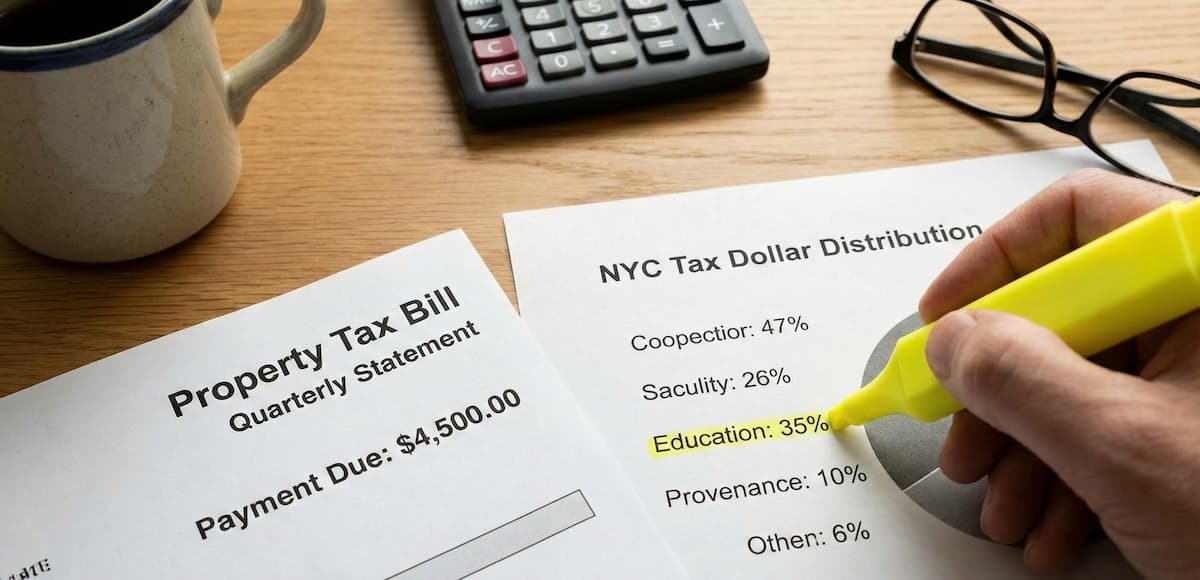
Property tax is New York City’s largest single source of revenue. In fiscal year 2024, it accounted for 44% of all city tax dollars collected. Those funds are critical to maintaining public services across all five boroughs.
Here’s how your property tax dollars were distributed in FY2024 [8]:
27%: Education
27%: Uniform Agencies (Police, Fire, Sanitation, Corrections)
21%: Health & Welfare
25%: Other Agencies (Transportation, Housing, Parks, and more)
This means every time you pay your NYC property tax bill, you’re directly contributing to schools, public safety, social programs, and infrastructure throughout the city.
What If You’re Late in Payments?
Paying your NYC property tax bill on time is critical. Missing a due date—even by a day—can result in interest charges that grow quickly and put your property at risk [9].
What Happens If You Miss the Deadline
- Late status: If your payment isn’t received or postmarked by the due date, it’s automatically considered late.
- Compounded daily interest: The Department of Finance (DOF) is legally required to add interest on overdue balances, and this interest compounds daily—meaning the longer you wait, the more you’ll owe.
- Risk of lien sale: If property taxes remain unpaid for too long, your property may be included in a tax lien sale, where the unpaid debt is sold to a third party. This could eventually lead to foreclosure if left unresolved.
Why You Should Contact the DOF Immediately
If you receive a letter about unpaid balances [10]—even if you believe it’s in error—contact the Department of Finance right away. Prompt communication allows them to correct mistakes, update your NYC tax records, and help you avoid unnecessary penalties.
It’s also your responsibility as a property owner to keep your address current with the DOF. If you don’t receive your NYC property tax bill, you’re still responsible for paying on time.
Payment Plan Options
The Department of Finance offers flexible payment plans [11] if you’re struggling to pay your New York City real estate tax bill in full:
- Standard Payment Plan: Spread your balance into smaller, more manageable installments.
- Property Tax and Interest Deferral (PT AID): Allows eligible homeowners facing hardship to defer payments temporarily.
- Reduced Interest Payment Plan: Offers lower interest rates for qualifying property owners.
You can use the DOF’s payment plan screening tool to see which option is best for your situation.
Frequently Asked Questions (FAQs)
Can I get a copy of my NYC property tax bill in the mail?
Yes, the NYC Department of Finance mails quarterly NYC property tax bills to property owners [12]. If you didn’t receive one, you can still access your bill online through the NYC Finance Property Search or NYC Tax Lookup portals [13]. Always confirm your mailing address is updated in NYC tax records to avoid missed notices.
How can I set up automatic payments for my New York City real estate tax bills?
If you’re on a payment plan, you can also choose Auto Debit [14] to have both your property taxes and any quarterly installment payments automatically deducted. NYC offers three autopay options:
- Monthly Pre-Pay
- Quarterly or Semiannual
- Annual Payment (July 1)
Additionally, if you’re enrolled in a monthly plan, you can still make a one-time payment through NYCePay, giving you flexibility on top of your automatic deductions.
Can I appeal the amount on my NYC property tax bill?
Yes, you can appeal your NYC property tax bill through the NYC Tax Commission if you believe the assessed value is too high, your property was placed in the wrong tax class, or an exemption was wrongly denied or revoked [15]. To do so, you must file an Application for Correction form with supporting documents in person or by mail before the deadline. A successful appeal may reduce your NYC real estate property taxes and lower future bills.
Are NYC property tax bills public record?
Yes, NYC property tax bills are public record and can be accessed through the Department of Finance’s Property Tax Public Access web portal [16]. Using the NYC tax search or NYC finance property search, you can look up details such as tax class, market value, and ownership, view NYC tax records like bills and annual notices of property value (NOPV), and even check or apply for exemptions.
What are the consequences of not paying my NYC property tax bill?
If your NYC property tax bill goes unpaid, the balance begins to accrue interest and late fees. Over time, delinquent New York City real estate tax bills may be included in the City’s annual lien sale [17], where the debt is sold to lienholders who can take legal action to recover payment.
Working with Tax Experts on NYC Property Tax Bills
The NYC property tax bill is an essential part of owning property in New York City, covering billing schedules, rates, exemptions, abatements, and payment options. Because assessments and regulations can change, many owners turn to professionals for clarity.
In New York City, Saranac Tax Services provides guidance to help property owners understand their NYC real estate property taxes and navigate local complexities.
Schedule a consultation with Saranac Tax Services today.
DISCLAIMER:The content is developed from sources believed to be providing accurate information. The information in this material is not intended as tax or legal advice. Please consult legal or tax professionals for specific information regarding your individual situation. Some of this material was developed and produced by FMG Suite to provide information on a topic that may be of interest. FMG Suite is not affiliated with the named representative, broker-dealer, state - or SEC - registered investment advisory firm. The opinions expressed and material provided are for general information, and should not be considered a solicitation for the purchase or sale of any security.
- NYC Department of Finance. Property tax bills and payments.
- NYC Department of Finance. Common payments and forms.
- NYC Department of Finance. Payment mailing addresses.
- NYC Department of Finance. In-Person.
- NYC Department of Finance. Property tax bills and payments.
- NYC Department of Finance. Property tax rates.
- NYC Department of Finance. Calculating your property taxes.
- NYC Department of Finance. Property tax bills and payments.
- NYC Department of Finance. Overdue balances and late payments.
- NYC Department of Finance. Late payments.
- NYC Department of Finance. Payment plans.
- NYC Department of Finance. Property tax bills and payments.
- NYC Department of Finance. Property Tax Public Access web portal.
- NYC Department of Finance. NYCePay Autopay Registration Instructions.
- The Official Website of the City of New York. Property Value Appeal.
- NYC Department of Finance. Property Tax Public Access web portal.
- 17. NYC Department of Finance. Lien sales.